Why Is My Mechanical Seal Leaking? Five Causes, and How to Tell Them Apart
A mechanical seal that leaks is telling you something about the pump, the fluid or the way it was fitted. Fitting an identical replacement without reading that message is how sites end up changing the same seal four times a year.
After looking at well over a thousand failures, nearly all of them come back to five causes.
1. Dry running
The faces need a thin fluid film between them. Take that away and the temperature at the interface climbs in seconds.
Signs: heat cracked or crazed hard face, blistered or badly worn carbon, discoloured metalwork, hardened and flattened elastomers.
Usual reasons: the pump was not vented on commissioning, the suction ran dry, the flush line is blocked or was never opened, or the pump is running against a closed discharge.
2. Abrasion and product build up
Solids in the pumped fluid work between the faces, or product crystallises just outside them and grinds the seal apart from the atmospheric side.
Signs: grooved or scored faces, an even matt finish rather than a polished band, hard deposits in the seal chamber or under the springs.
Usual reasons: no flush, the wrong flush plan for a slurry, or a crystallising product with no quench on the atmospheric side.
3. Chemical or thermal attack on the elastomers
The faces can be perfect and the seal still leaks because the O rings have hardened, swollen or been chemically stripped.
Signs: O rings that are brittle, cracked, spongy, swollen or set flat, sometimes noticeably changed in colour.
Usual reasons: the wrong elastomer for the chemistry, cleaning chemicals nobody mentioned, steam sterilisation on a material that cannot take it, or a temperature at the faces higher than the temperature in the tank. This is where FFKM earns its cost, and where FKM frequently does not stretch far enough.
4. Installation error
Signs: leaks from new, a seal that lasted days, cut or nicked O rings, faces with a fingerprint or a scratch, an unevenly tightened gland.
Usual reasons: wrong setting length on a component seal, setting clips removed at the wrong stage on a cartridge, no lubricant on assembly, and lapped faces touched with bare fingers.
Our fitting guide covers the sequence that removes most of these.
5. Shaft movement
A seal can only follow so much movement before the faces part.
Signs: uneven wear band across the face, fretting under the dynamic O ring, repeat failures on one specific pump.
Usual reasons: coupling misalignment, pipe strain pulling the casing, worn bearings, cavitation, or running a long way off best efficiency point.
How to read the leak itself
- Weeping from the gland face: gasket or flatness problem, not the seal faces.
- Leaking down the shaft under the seal: the dynamic elastomer or the sleeve.
- Spraying from the seal face area: faces separated. Look at dry running, solids or shaft movement.
- Only when hot: thermal growth, elastomer hardening, or a flush that cannot cope at temperature.
- Only at start up: venting and priming.
Before you fit another seal
Answer four questions in writing:
- What is the actual fluid, including cleaning chemicals?
- What is the temperature at the seal chamber, not in the tank?
- What is the seal chamber pressure and is the flush plan right for it?
- How long did the last three seals last, and did anything change?
If you cannot answer them, the next seal is a guess.
We supply cartridge seals, component seals, oil seals and FFKM O rings across the UK, with same day despatch on common sizes ordered before 2pm.
Andrew Sykes MCGI, 36 Years Solving Seal Problems
Photograph the failed faces and send them to Acumen Seals. I will tell you what killed it.
Questions and answers
Why is my mechanical seal leaking?
In practice there are five common causes: dry running or poor venting, faces damaged by abrasives or crystallised product, elastomer attack or hardening from chemistry and temperature, incorrect installation such as wrong setting length or a damaged O ring, and shaft movement from misalignment, pipe strain or worn bearings.
Is it normal for a mechanical seal to leak a little?
A correctly running mechanical seal leaks a very small amount that usually evaporates, so you see nothing. Visible drips, a steady weep or spray are not normal and mean the faces are no longer running together properly.
How much leakage is acceptable from a mechanical seal?
For a typical single seal on water like duty, anything you can see collecting is too much. Emissions standards for hydrocarbon service are far tighter again. If you are catching drips in a tray, the seal is failing, not settling in.
Can a leaking mechanical seal be repaired?
Sometimes. If the faces are intact and the leak is from an elastomer, a gland gasket or a setting error, the seal can be stripped, cleaned, refitted with new elastomers and returned to service. If the faces are cracked, blistered or grooved, they need relapping or replacing.
Why does my mechanical seal leak on start up but not when running?
That usually points to face separation at low speed or pressure, hydraulic upsets during priming, or a seal chamber that is not fully vented so the faces run dry for the first few seconds. Check the venting routine and the flush plan before you replace anything.
How do I know if it is the seal or the pump?
If the same pump destroys seals on a repeatable timescale, the pump or the duty is the problem. Look at suction conditions, operation away from best efficiency point, bearing condition, coupling alignment and pipe strain before you buy another seal.
Solutions related to this article
If this failure mode sounds familiar, these are the products and services that usually fix it.
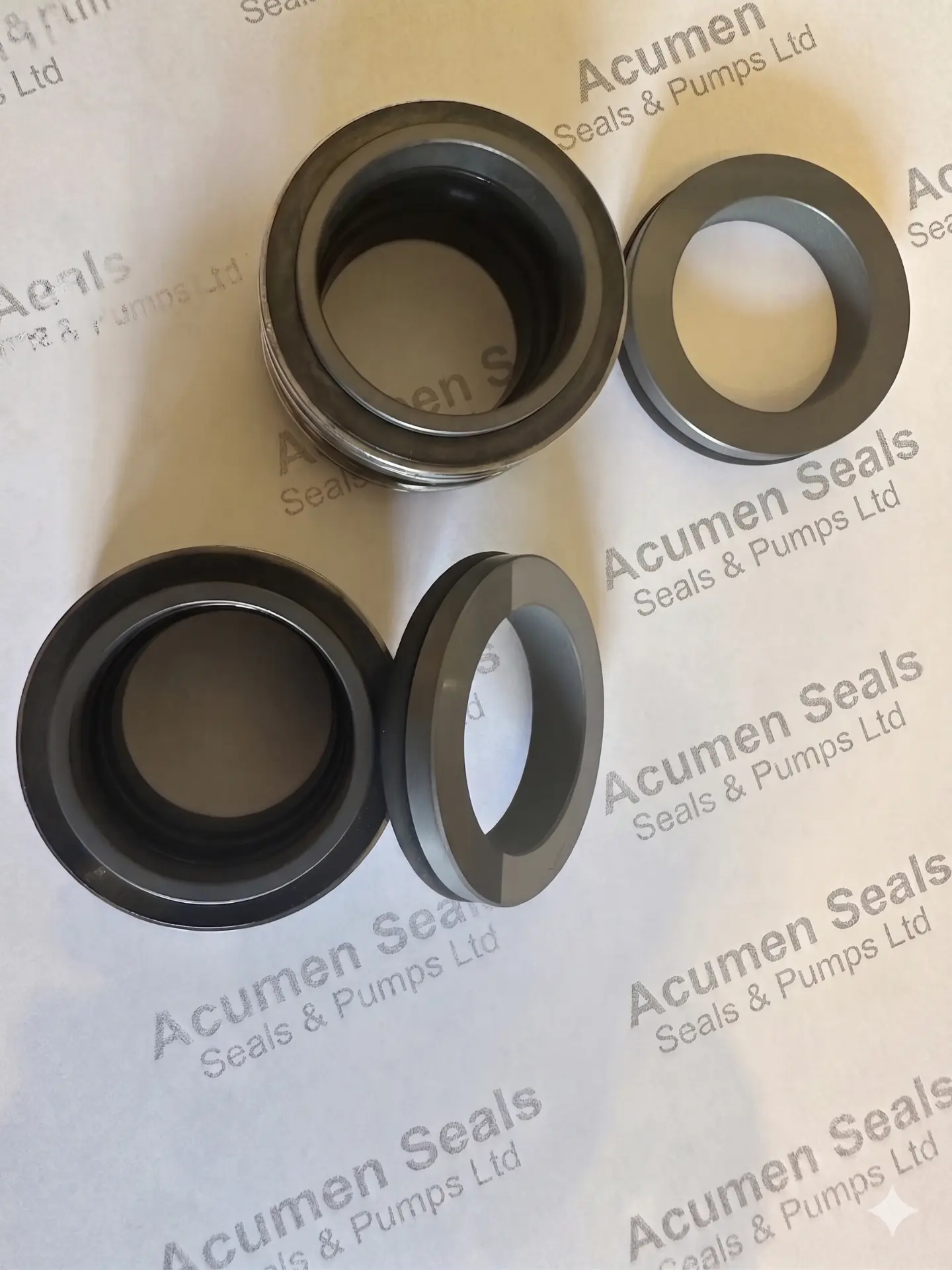
- Component SealsSeal faces, springs, bellows and secondary seals in carbon, silicon carbide and tungsten carbide.View details
- FFKM O-RingsPerfluoroelastomer O-rings for aggressive chemistry and temperatures to 325C.View details
- Cartridge SealsPre assembled seal units that remove setting errors on pumps, mixers and agitators.View details
Experiencing a Seal Failure?
Get expert advice and fast solutions from Acumen Seals & Pumps. With 36+ years of experience, we solve seal problems quickly and efficiently.
Founder and Mechanical Seal Specialist, Acumen Seals & Pumps
Published on 2026-09-07
45 years in engineering and 36 years in sealing. Andrew specifies, supplies and troubleshoots mechanical seals, FFKM elastomers and pump sealing systems for UK industry.
More about Andrew